 |
||||||||
 |
||||||||
 |
||||||||
|
||||||||

 |
| [discount_rates_problem] [long_term] [riskpremia_historic] |
|
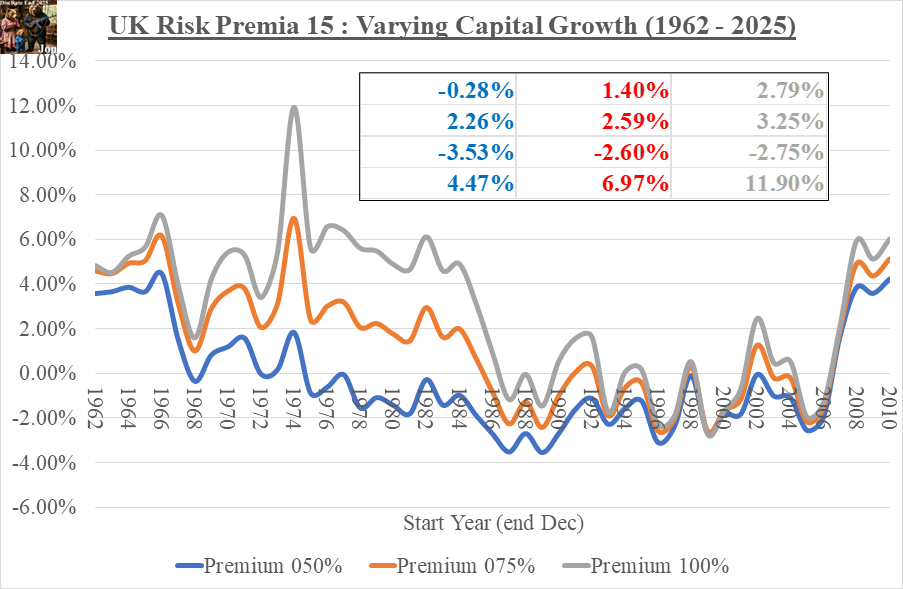
It has been common to assess equity risk premia (the return difference between returns on equities and bonds), allowing for all of the capital growth observed in the past. In fact, the main volatility in equity returns stems from realised capital growth (which may well be transient) rather than from dividends. The chart below looks at what the risk premia over periods of 15 years would have been if the capital return component had been 50% (“Premium_050%”) OR 75% OR 100% of what had been observed. The rows in the table are mean, standard deviation, minima and maxima. On average, between 1962 and 2025, the capital component of the total equity return over 1 year was 59%, slightly lower than the 61% seen in the previous 2 years. For periods of 15 years starting from 1962, the equity return capital component (chart here) averaged 56% of the total return (standard deviation 15%), virtually unchanged from the previous 2 years. Interestingly, 50% was assumed throughout the 1980s by at least one major consultancy. If capital had accounted for 55% OR 70% OR 86% of the total equity return, then the average equity risk premium over periods of 15 years would have been zero OR 1% pa OR 2% pa.
|
 |
|
|